Glossary of Integrated Circuit Terminology - D
- Darlington - a transistor pair where the two transistor's collectors are tied together and the emitter of the first transistor feeds the base of the second transistor. Darlington pairs can provide very high gain since the gain of the two transistors are multiplied together. Days Per Mask Layer - the cycle time in days divided by the number of mask layers in the process. A common metric of cycle time performance.
- Deal-Grove Oxidation Law - a theory of oxidation formulated by Bruce Deal and Andy Grove describing oxidation of silicon. The theory basically states that initially the oxidant reacts directly with the silicon surface and the reaction rate determines the oxide growth rate, as oxidation proceeds, a layer of oxide forms and at a sufficient thickness the oxidant must diffuse through the oxide to react with silicon, and the diffusion rate controls the rate of oxide growth, i.e., diffusion is slower than the surface reaction rate.
- Deep Ultraviolet Light - electromagnetic waves with a wavelength of 100 to 300 nanometers.
- Defect - an imperfection in a film or pattern. Defect Density - the number of killer defects per unit area on a wafer.
- Dehydration Bake - a bake step to drive moisture off of a wafer surface prior to coating.
- Depletion Device - a MOSFET that is on until turned off by depleting the channel of carriers.
- Depletion Region - an area of a semiconductor where all of the mobile carriers have been swept out by an electric field. The depletion region is depleted of carriers hence the name.
- Depreciation - a percentage of the cost of capital equipment is written off each year and is called depreciation. Typically five year for process equipment, ten years for facility systems and thirty years for the bricks and mortar.
- Depth of Focus - the distance away from the focal plane that an image may be and still meet a given resolution specification.
- Developer - a solution used to resolve an image after exposure. For a positive photoresist the developer has a higher attack rate on the exposed portion of a photoresist than on an unexposed portion of the photoresist. For a negative photoresist the developer has a high attack rate on the unexposed portion of the photoresist than on the exposed portion of the photoresist.
- Developing - the process of allowing developer to interact with photoresist to form an image. Developing of negative photoresist is most commonly by spraying developer onto the wafer surface, positive photoresist may be developed by immersion or spray. For positive photoresist developing temperature is very critical.
- Deionized Water - water from which the majority of ions have been removed. Tap water has resistivity of <50 kiloohms, deionized water may have resistivity as >18 megaohms. The term deionized water has been largely replaced by ultrapure water to indicate that more than just low ions counts are required.
- DI Silicon - see Dielectrically Isolated Silicon.
- DI Water - see deionized water.
- Diborane - chemical formula B2H6, diborane is a highly toxic gas with a TLV of 0.1ppm, and will automatically combust in the range of 0.8-98% in air. Diborane has a repulsive, sickly smell. Diborane is used as a boron source for ion implantation and to a lesser extent for furnace and CVD doping.
- Dichlorosilane - chemical formula H2SiCl2, dichlorosilane is a flammable, corrosive, and is combustible in the range of 4.1-98.8%. Dichlorosilane has a strong pungent odor and is irritating to lungs, skin and eyes. Dichlorosilane is used in epitaxial and silicon nitride deposition.
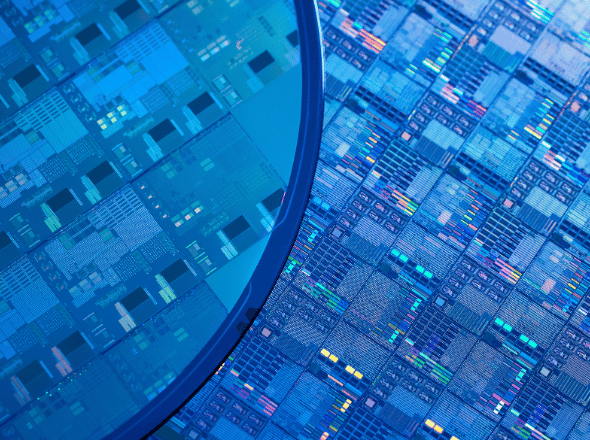
- Die - An individual integrated circuit or discrete device. When a wafer is completed through the fabrication process the surface of the wafer contains many individual die, also called chips.
- Die Area - the length of a die multiplied by the width of the die.
- Die Attach - the process of attaching a die onto some type of packaging component or carrier, for example a leadframe.
- Die Bonding - the process of attaching a die down to an underlying substrate, most commonly a leadframe.
- Die Cost - the cost to produce a good die through the wafer fabrication and wafer test steps.
- Die Size - the size of a die. May be expressed as the length time the width or in area.
- Die Sort - the process of sorting out good and bad die on a wafer. See, wafer test.
- Die Yield - the number of good die divided by the number of die tested. Also referred to as the probe yield. Die yield is commonly reported on a per wafer or per lot basis. On a per wafer basis the die yield would be the number of good die dived by the gross die on the wafer.
- Dielectrically Isolated Silicon - a wafer with silicon tubs that have an insulator, typically silicon dioxide on all four sides and the bottom. Historically dielectrically isolated silicon has been made using a V-Groove technique that was limited to a maximum wafer size of 125mm. Recently SOI with insulator-filled etched-trenches has been used.
- Diffraction - the spreading or bending of light that occurs when light passes around an edge.
- Diffraction Orders - light passing through a slit that is small in comparison to the light wavelength shows a center intensity peak and then a group of peaks on either side of gradually decreasing intensity as the peaks get farther from the center peak. Each peak is a diffraction order, the center peak is order 0 and each peak to the right is numbered +1, +2, +3, etc. in sequence, to the left the peaks are -1, -2, -3, etc. in sequence.
- Diffusant - a substance undergoing diffusion.
- Diffused Layer - a layer formed by diffusion.
- Diffusion - a process whereby a substance redistributes from an area of relatively high concentration to an area of relatively low concentration due to random thermal motion. The larger the concentration gradient the faster diffusion occurs for a given temperature, conversely, the higher the temperature the faster diffusion occurs for a given concentration gradient.
- Diffusivity - the temperature depedent rate that an impurity diffuses.
- Diffusion Depth - the depth at which the concentration of a diffused impurity is equal to the concentration of background impurities in the semiconductor.
- Digital - a signal in an electrical circuit that is limited to certain discrete values.
- Digital Signal Processor - special purpose processing unit designed to execute specific algorithms on digitized waveforms, nearly always in real time.
- Dimer - a compound formed by a union of two simpler compounds or elements.
- Diode - a semiconductor device made up of a single junction between an N-Type and a P-Type area. Diodes allow conduction in only one direction.
- Dip - a brief immersion in an etchant to remove a thin layer or the top surface of a thicker layer.
- DIP - Dual In Line Package - an older style integrated circuit package with two parallel rows of pins designed to be inserted through holes in a printed circuit board. DIPs still account for approximately 13% of Package types shipped on a unit shipment basis. The use of DIPs is declining.
- Direct Current - electrical current that remains of one polarity.
- Direct Labor - the people who directly process the wafers, sometime referred to as "touch labor". Direct labor does not include support people such as equipment and process technicians, engineers, supervisors and managers.
- Direct Step Wafer - an older terminology for stepper.
- Discrete - a single semiconductor device per die or packaged product, as opposed to an integrated circuit that is more than one semiconductor device per die.
- Dispersion - the variation in index of refraction of a material versus wavelength of light.
- DMOS - see Double Diffused Metal Oxide Semiconductor.
- Donor - group five elements in the periodic table such as phosphorus, arsenic and antimony have one more electron in the outer most energy level than silicon. When these atoms are introduced into silicon, an impurity level is created very near the conduction band. At zero degrees Kelvin the impurity level is filled, at room temperature sufficient energy is available to excite electrons from the impurity level into the conduction band. Because these elements introduce impurity levels that donate electrons they are referred to as donors.
- Dopant - an Impurity added to a semiconductor to change the number of holes and electrons relative to each other.
- Doping - the process of introducing a dopant. Doping is most commonly accomplished by ion implantation although historically doping was accomplished by pre-deposition.
- Double Diffused Metal Oxide Semiconductor (DMOS) - a type of MOS device where the channel is formed by the difference in diffusion depth between two diffused layers. Very commonly used for high voltage and or high power MOS devices.
- Downtime - time that a piece of equipment is not available to production, generally due to the equipment being broken or undergoing preventive maintenance.
- Drain - the end of a MOSFET that drains carriers that have transited the channel. The MOSFET equivalent of a bipolar collector.
- DRAM - see Dynamic Random Access Memory.
- Drive-In - a diffusion step following pre-deposition. Drive-in increases the diffusion depth of a pre-deposition, pre-depositions are commonly masked by silicon dioxide, if a long diffusion took place during pre-deposition the pre-deposition dopant could penetrate the masking oxide and enter the silicon where it isn't wanted. Following pre-deposition a dip is used to clean off the oxide surface so that it is dopant free prior to drive-in.
- Dry Etch - a process whereby etching is accomplished by a reactive gas as opposed to a liquid. Dry etching techniques include plasma etch, reactive ion etch , magnetically enhanced reactive ion etch, inductively coupled plasma, electron spin resonance, etc.
- Dry Strip - see Ashing
- Dry Oxidation - oxidation of silicon using dry oxygen.
- DSP - see Digital Signal Processor.
- DSW - see Direct Step Wafer.
- Dump Rinser - a rinse system where a tank alternately fills up with water and then dumps automatically. Typically 3 to 5 fill and dump cycles are used.
- DUV - See Deep Ultraviolet
- Dynamic Random Access Memory - a type of semiconductor memory where data may be accessed at random and data must be continuously refreshed. DRAM's will only hold data for a few milliseconds so the data must be read and rewritten every millisecond or so.
- Copyright © 2000 - 2004 IC Knowledge - all rights reserved.